The Walker’s Choice: How the Built Environment Shapes Our Path
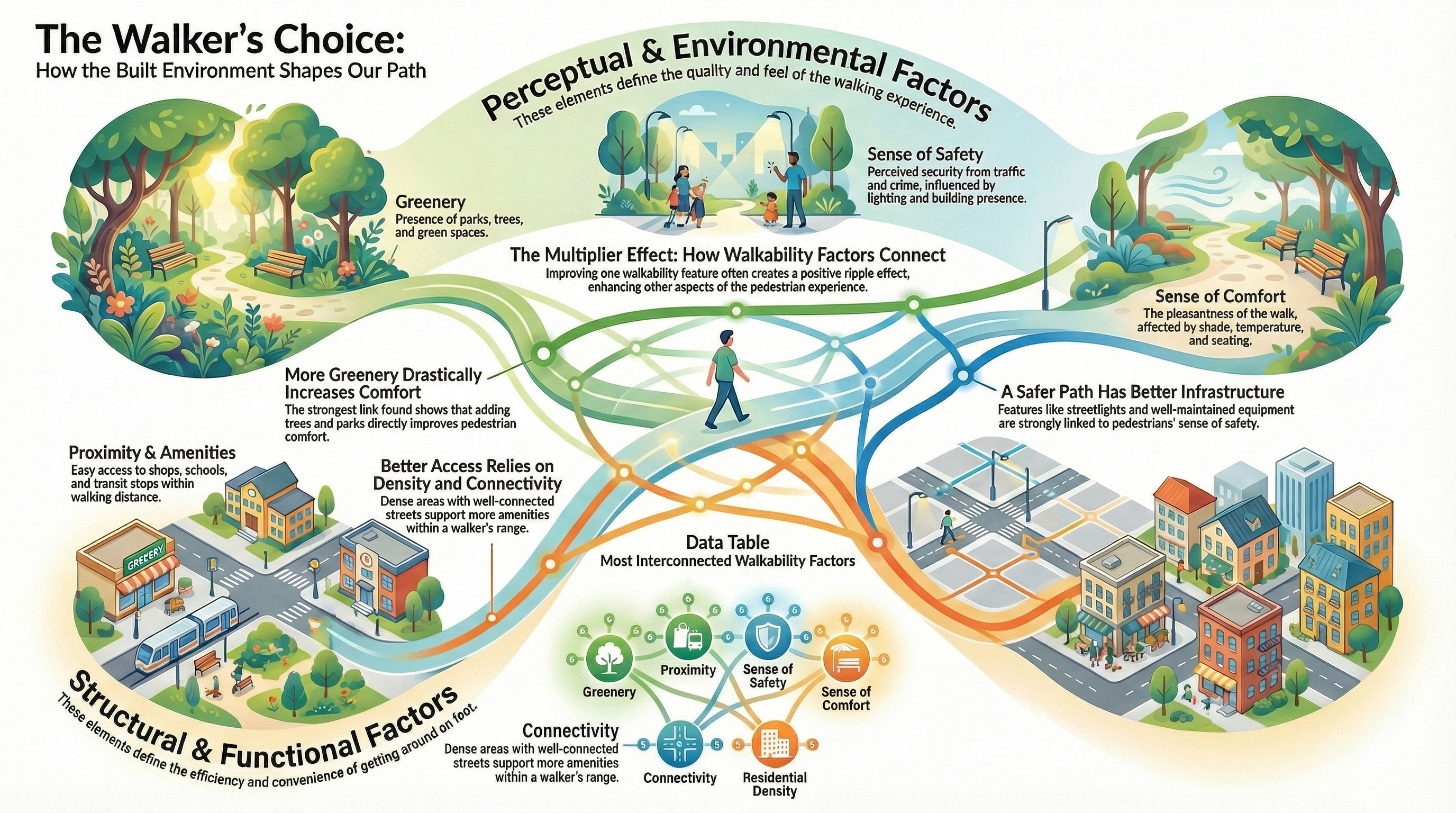
When people walk from Point A to Point B, they rarely choose a route based only on distance.
Their decisions are influenced by the built environment, combining spatial structure, environmental quality, and human perception.
This infographic is based on my own research and developed as part of an ongoing academic paper on walkability. The study investigates how different walkability factors interact and how they influence pedestrian behavior and route choice in urban environments.
Perceptual & Environmental Factors
Factors such as greenery, sense of safety, lighting, visibility, and comfort play a major role in how a walking route is perceived.
One of the key findings from my research shows that greenery has a strong and direct impact on pedestrian comfort, while perceived safety is closely linked to environmental design and infrastructure quality.
Structural & Functional Factors
Urban form defines what is accessible on foot:
-
Street connectivity shapes route efficiency and choice
-
Residential density and proximity to amenities expand walkable opportunities
The Multiplier Effect
A core contribution of this research is the identification of a multiplier effect among walkability factors.
Improving one element, such as greenery or connectivity, can positively influence others, including comfort, safety perception, and overall walking experience.
The network diagram highlights the most interconnected walkability variables, showing that greenery, proximity, safety, comfort, and connectivity sit at the core of pedestrian decision-making.
Key insight from the ongoing paper:
Walkability is not only about infrastructure, but it is also a human-centered experience, shaped by how people perceive and interact with the urban environment.
This research aims to support more evidence-based, walkability-oriented urban design and planning decisions.