Back to Blog
Article
Walkability in urban area: examining the role of built environment and city structure in Milan
December 14, 2025
40 views
4 Surprising Truths That Redefine What Makes a City “Walkable”
Introduction: Beyond the 10-Minute Walk
When we picture a "walkable" neighborhood, certain images come to mind: charming cafes with sidewalk seating, well-maintained footpaths, and essential shops just a short stroll away. For decades, this has been the gold standard—a simple equation of proximity and good pavement. But this definition, while useful, only scratches the surface of what makes a street truly inviting for pedestrians.
Our understanding of walkability is undergoing a profound evolution. Armed with advanced tools like Geographic Information Systems (GIS) and artificial intelligence, researchers are now able to analyze our urban environments with unprecedented detail. They are moving beyond simple checklists to measure the complex, often invisible, factors that shape our experience on foot.
This article shares four of the most surprising and impactful takeaways from a new study that created a highly detailed, multidimensional walkability index for a case study of Milan, Italy. These findings challenge our old assumptions and reveal a more nuanced, fascinating picture of what it takes to build a city that is genuinely made for walking.
--------------------------------------------------------------------------------
1. It’s Not Just Concrete, It’s a Canopy: Why Greenery is a Walkability Superpower
While we intuitively appreciate a tree-lined street, new data reveals that greenery isn't just a pleasant bonus—it is a core, functional component of a walkable environment. In fact, the single strongest relationship discovered in the research was between the amount of greenery in an area and a pedestrian's "sense of comfort."
The data revealed a connection so powerful it stands in a class of its own. It registered a Pearson correlation coefficient of
r = 0.81 (a statistical measure where 1.0 is a perfect correlation), a figure the study describes as a "very strong positive correlation." For context, a score this high is exceptionally rare in social and environmental science, solidifying with shocking force what many have only intuited.This isn't just about aesthetics. The practical benefits of a robust urban canopy are substantial, providing critical shade that lessens the urban heat island effect, improving air quality, and creating an overall atmosphere that makes walking more pleasant. The research confirms that a city's investment in its green infrastructure is a direct investment in its pedestrian experience.
This suggests that greenery may play an important role in shaping the perceived quality of the pedestrian experience.
--------------------------------------------------------------------------------
2. Your Neighborhood’s “Walkability Personality” Matters More Than a Single Score
Popular tools like "Walk Score" have done a great job of raising awareness, but they often boil down the complex character of a neighborhood to a single number. This new research shows that walkability is less like a final grade and more like a unique "personality profile," with distinct strengths and weaknesses.
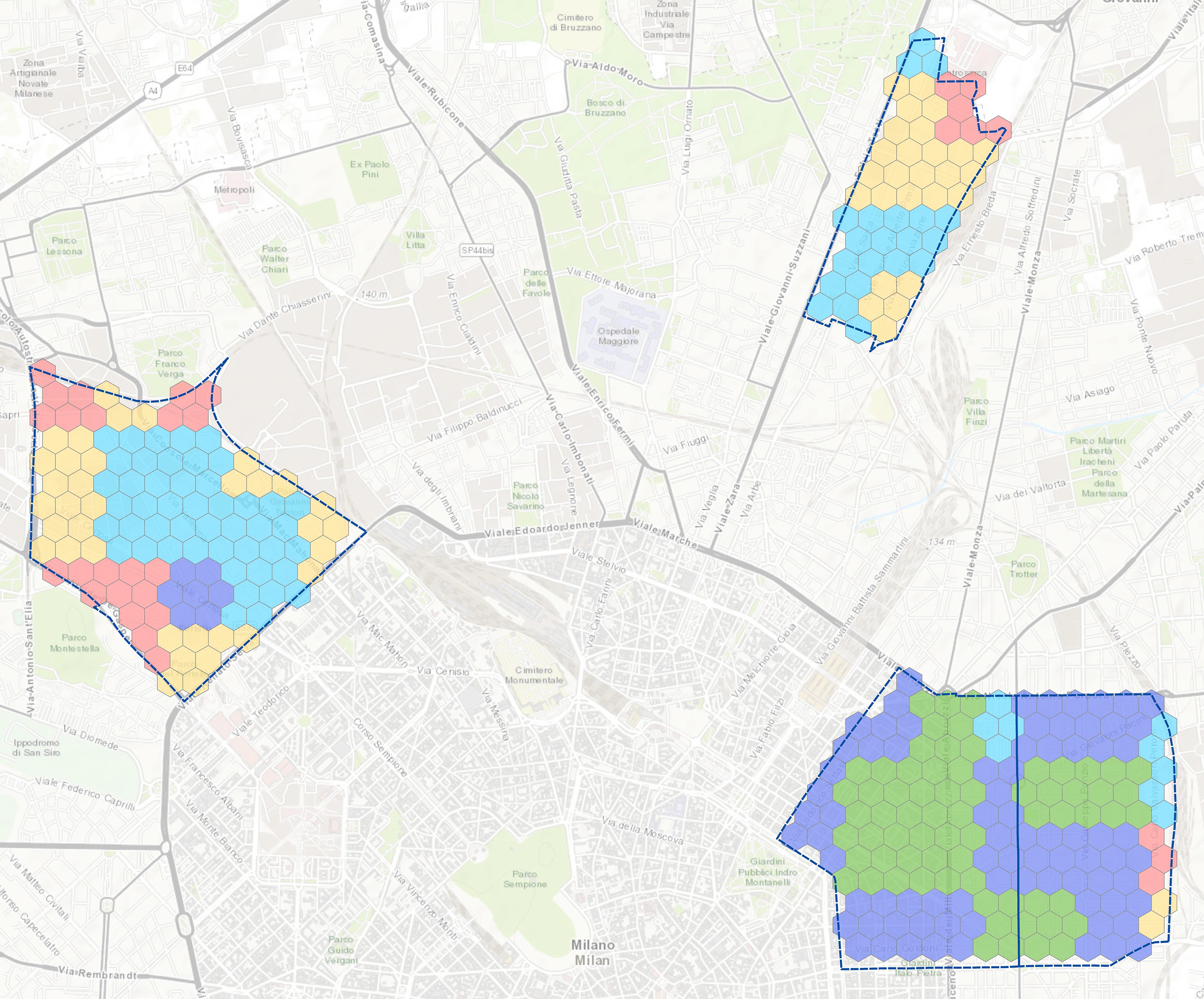
A case study that analyzed four different neighborhoods in Milan provides a perfect example, from which two areas provide a particularly illuminating contrast:
• Nil 21: This neighborhood achieved the highest overall score, driven by its "compact form and accessibility." Its personality was defined by excellence in 'Proximity' to amenities and high 'Residential Density', making it a classic example of a convenient urban core.
• Nil 22: This area also performed well, but its profile was different. It stood out for its high scores in 'Sense of Comfort' and 'Street Equipment', suggesting a neighborhood that is exceptionally well-managed and designed with the resident's daily experience in mind.
In other words, a resident in Nil 21 experiences walkability as effortless convenience, while a resident in Nil 22 experiences it as exceptional comfort and care. This nuanced view is critical for urban planners, allowing them to identify a neighborhood's specific personality and make targeted, effective improvements rather than applying a one-size-fits-all solution.
--------------------------------------------------------------------------------
3. A “Sense of Safety” Is Something We Can Actually Build and Measure
For a long time, a pedestrian's "sense of safety" was considered a purely subjective feeling—important, but difficult to quantify and engineer. This study demonstrates that this perception is directly tied to a collection of objective, measurable, and buildable features of the streetscape.
The 'Sense of Safety Index' was constructed from seven tangible indicators that cities can directly control:
• Street tree canopy
• The number of buildings along a block
• The presence of Zebra crossing markings
• Street segment lengths
• Adequate lighting
• Regulated street speed
• The presence of separate bike lanes
To gather this data at scale, the researchers used a deep learning AI model to automatically scan imagery and map every single zebra crossing in the study area. This automated approach allowed the researchers to map every crosswalk across four dense urban neighborhoods in a fraction of the time it would have taken a team of human surveyors, making city-wide safety audits feasible for the first time. It’s a breakthrough because it allows cities to move from vague safety goals to specific, data-driven interventions.
…a pedestrian's Sense of Safety was significantly correlated with Street Equipment (r = 0.63) and moderately correlated with Sense of Comfort (r = 0.54).
--------------------------------------------------------------------------------
4. The Planner’s Dilemma: The Easiest Fixes Aren’t Always the Most Impactful
Perhaps the most revealing insight for city leaders is the tension between what is easy to change and what truly makes a difference. To move this from a qualitative talking point into a quantifiable framework, the researchers introduced the concept of "transformability," creating a weighted score to balance a variable's theoretical impact against its practical feasibility. The results highlight a classic urban planning dilemma.
• Hard to Change: Core features like the mix of 'Land uses' are foundational. The study notes that modifying a city's land use is extremely difficult, but its impact is powerful and long-lasting.
• Easy to Change: Surface-level features like 'Pedestrian equipment' are highly transformable. Adding benches or bike racks is a relatively quick and visible project. However, the research found these elements had weaker correlations with other key walkability factors.
This data exposes the seductive trap of cosmetic urbanism: the quick, visible win of a new park bench often comes at the expense of the slow, generational work of rezoning for mixed-use density—the very change that creates truly walkable communities.
--------------------------------------------------------------------------------
Conclusion: Seeing Your Streets with New Eyes
A truly walkable city is far more than a checklist of sidewalks and shops. As the deep dive into Milan's neighborhoods reveals, it is a complex ecosystem where the shade from a tree, the security of a well-lit crosswalk, and the underlying urban form are all deeply interconnected. Moving beyond a single score to understand a neighborhood's unique walkability personality is the future of people-centric urban design.
This research gives us a new lens through which to see our own communities. The next time you walk through your neighborhood, what will you notice differently? Is it the quality of the street equipment, the comfort provided by the tree canopy, or the sense of safety at an intersection? And what one change do you think would make the biggest difference to the way you experience your city on foot?